

No chief financial officer would approve a capital expenditure with a 60% failure rate, no measurement framework, and no post-investment review. Yet that is precisely what most organisations do when they promote someone into a leadership role.
A high potential manager has all the right qualifications on paper, beats KPIs, and is seen by everyone as confident and ready to move into an organisation-wide leadership position. Yet, when challenged by peers in a cross-industry project, he or she is unable to resolve conflicting opinions and pivot to consensus building within the agreed time allocation.
The appointment of a senior leader is a capital-allocation-grade decision with a high cost of failure, a long tail of consequences, and a commitment that is largely irreversible in the short term. The direct replacement cost of a failed appointment runs between two- and four-times annual salary. McKinsey estimates the downstream damage at $2.7 million per year for every hundred employees managed by an unprepared leader. One bad promotion degrades performance across an entire unit and triggers a cascade of unmeasurable financial loss.
Research shows that 60% of newly promoted managers fail within 24 months, a rate that points to structural factors in decision-making rather than individual misjudgement. CEOs and management teams who know they must avoid these costs need to understand what about the process is broken and what can be done to fix it.
When organisations select leaders, they typically draw on three categories of evidence: past performance, psychometric assessment, and professional credentials. Each is structurally compromised. The problem is not a lack of data, but that the data most organisations collect is not what actually predicts whether someone can lead.
Past performance is the most immediate signal, and often the most implicitly trusted. It is also the most misleading. A landmark NBER study tracking 53,035 workers across 214 firms found that doubling a worker’s pre-promotion sales performance increased their likelihood of promotion by over 14%, yet predicted a 7.5% decline in the performance of their subordinates once promoted. In contrast, prior collaboration experience improved subordinate performance by 12 to 16%, the single strongest predictor of managerial effectiveness, yet firms systematically underweight it. Success in an individual role rewards personal execution; success in a leadership role requires enabling others to execute. These are different capabilities, and excellence in one is frequently a poor indicator of ability in the other.
The failure of psychometric assessments is subtler. These tools measure what candidates say they would do in controlled conditions. They cannot replicate the identity shift required in moving from individual contributor to team leader, nor the authority gap that constrains real managers: 44% of promoted managers identify the peer-to-manager transition as their primary difficulty. Business-school case simulations compound the issue: in Mintzberg’s formulation, they present “an artificially simplified world,” producing confidence without competence.
Credentials, meanwhile, serve as a selection filter rather than a proof of capability. IZA econometric research using within-person fixed-effects models found that the perceived signalling value of elite credentials yields roughly a 22% starting wage premium, but the perceived human-capital value, the actual learning, is statistically indistinguishable from zero.
All three inputs measure proxies for leadership rather than leadership itself. The core validity issue is that nobody has watched this person lead under real conditions.
If selection is structurally flawed, the obvious remedy is development. Yet executive education is an industry that operates with remarkably little accountability for outcomes. A 2024 systematic review by Geerts, spanning 172 studies including 30 that met gold-standard criteria, found that as few as 5% of participants successfully transfer learning from classroom-based leadership programmes to the workplace.
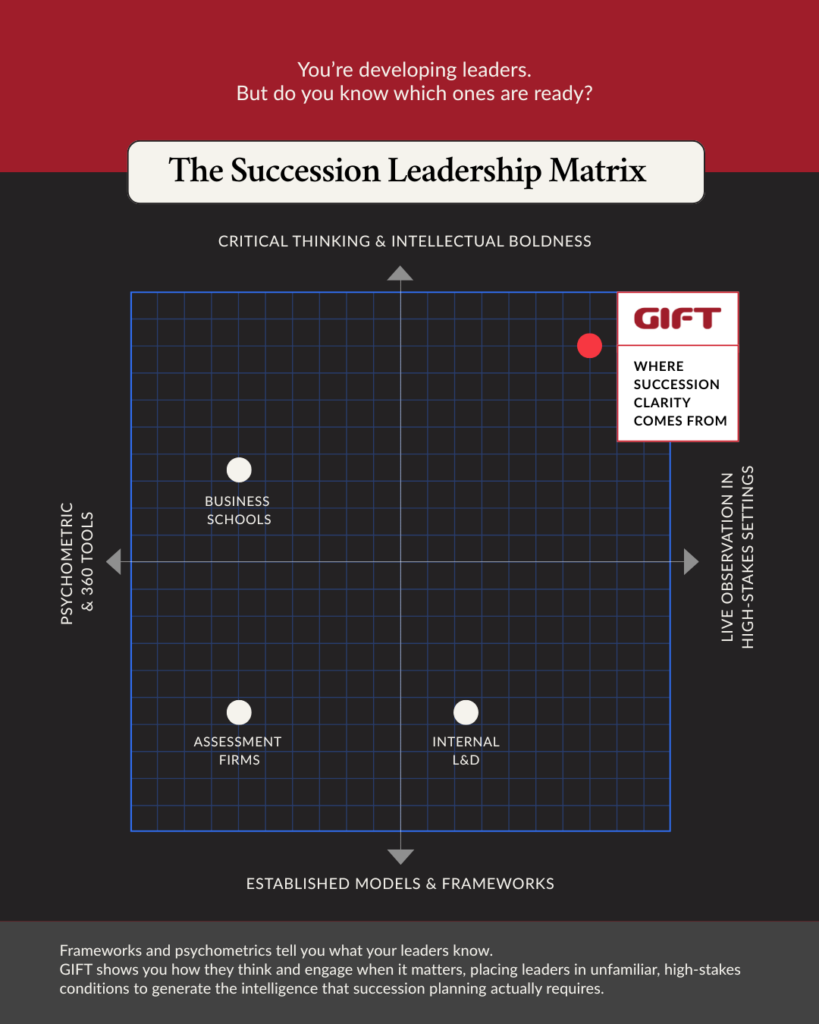
Across 31 flagship programmes at 12 elite institutions, including Harvard, Stanford, Wharton, INSEAD, and others, there is no published data on promotion rates, employer-reported performance improvements, or independently verified behavioural change. Despite programme fees regularly exceeding $100,000, just 6% of organisations regularly measure financial return on executive education investment. Nearly half never measure it at all. Nobody was ever fired for sending high potentials to Harvard, because the purchasing logic is reputational risk-mitigation, not investment with expected returns.
This is not a training budget problem; it is a decision-quality problem. Failures in selection and failures in development share the same structural shortcoming: neither is grounded in observation of actual leadership behaviour under real conditions, including navigating uncertainty, responding to pressure, and facing real consequences.
The fix is not necessarily better programmes, though ensuring learning outcomes are fit for purpose and ROI is tracked would help. What is needed is a different category of input altogether which is systematic observation of leadership behaviour in live business conditions, before the promotion decision, not as remediation after it.
Some organisations are already moving in this direction, embedding high-potential candidates in cross-functional project teams twelve to eighteen months before any promotion decision. Others are prioritising experiential field-based project work with cross-industry teams, with structured observation by external facilitators against desired culture frameworks and aspirational leadership behaviours. Succession leadership talents must be tested in real situations, under pressure and ideally with project outcomes that have real consequences for stakeholders as this is what elicits insights into how they respond when it matters. Selection and development become a single, integrated process rather than separate organisational functions that happen to involve the same people.
Organisations that specify, in writing, what outcomes they expect from leadership development, and how those outcomes will be measured, by whom, and over what timeframe, can begin course-correcting immediately. The rest will continue to operate the most expensive decision in their organisation on the least valid evidence available.
For organisations ready to change, the next GIFT Global Leaders Programme (GLP) begins this May.

Eric Stryson is Managing Director of the Global Institute For Tomorrow (GIFT) in Hong Kong. He possesses expertise in governance, business model innovation, leadership transformation, talent development, and sustainability. He coaches leaders from business, government, and civil society to critically examine their roles, look beyond conventional wisdom, deepen their understanding of global issues, and take ownership of their impact on their organisations and society at large.